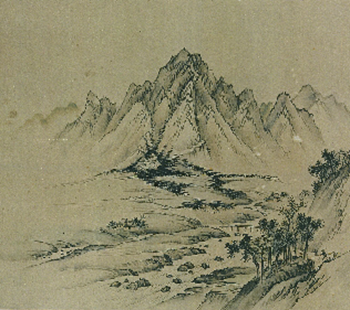
Kozuke-ni-kuni Myogi-san (“Mt. Myogi in Kozuke Province”)
Located in western Gunma Prefecture, Mt. Myogi is a mountain of about 1,104 meters in height, one of the three mountains comprising “Jomo Sanzan,” along with Mt. Akagi and Mt. Haruna. Severely eroded and weathered, it is a famous tourist destination with many marvelously shaped peaks and rocks. This painting successfully depicts the radiant appearance of the mountain, its ruggedness strikingly complementing the powerful flow of the river descending from it. Other elements also create perfect harmony, including the houses at the foot of the mountain, forests, and bushes, as well as dot-like figures in front of the bridge.
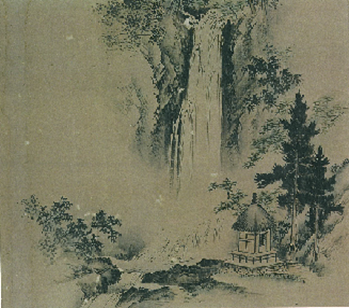
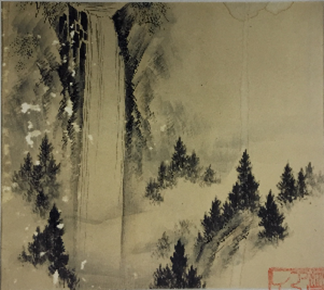
Settsu-no-kuni Mino’o-yama (“Mt. Mino’o in Settsu Province”)
About one kilometer from Hirao upstream along the Mino’o River is Ryuan-ji Temple, from which another kilometer-plus upstream is the waterfall depicted in this painting, with a height of about 48 meters. This waterfall also inspired Tsumori no Kunisuke to compose a waka poem, which is included in the Fuboku-wakasho, a waka collection compiled in the early 14th century: “Each time I forget, I wonder if it’s the sound of rain, yet it proves to be the sound of the waterfall, making me wish I could borrow a mino (straw raincoat) included in the name of Mt. Mino’o.” This is the second most famous waterfall in the Kansai region after Nachi Falls. This painting depicts a pavilion in front of the waterfall, but it is said that no one was able to stay there due to the thunderous roar of the waterfall.
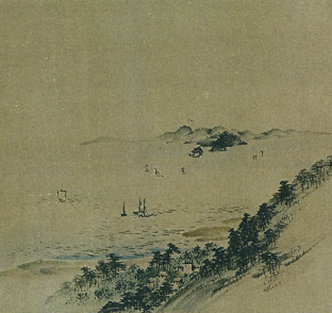
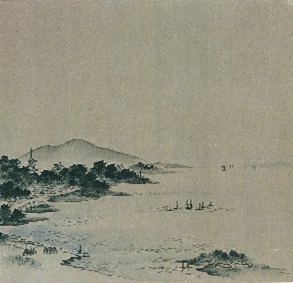
Harima-no-kuni Sumanoura (“Sumanoura in Harima Province”)
Sumanoura is a coastal area in present-day Suma Ward, Kobe City. Along with Akashi, this area is famous for its beautiful scenery featuring white sand and pine trees with green leaves, especially under the moon. Offering a remote view of Awaji Island across the Akashi Strait, Sumanoura was a resort for the nobility in the Heian Period (roughly from the ninth to the late 12th century) and later. It is also home to many historic sites, including Ichinotani, the famous scene of a historic battle between the Minamoto and Taira clans. A poem by Matsuo Basho reads: Suma-dera ya / fukanu fue kiku / koshitayami (“At Suma-dera Temple, I feel as if I heard the sound of a flute under the dark shade of tree leaves, even though nobody is playing it.”) It was inspired by the famous episode of the death of Taira no Atsumori in the Tale of the Heike, and the flute mentioned here is the one cherished and left behind by the warlord.
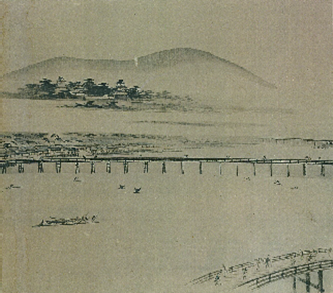
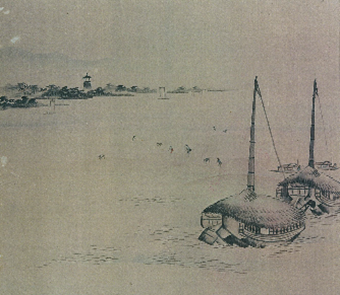
Suruga-no-kuni Sandaikyo(“Three Major Bridges in Suruga Province”)
Three major rivers flow into the Suruga Bay: the Fuji, Abe, and Oi Rivers. The Tokugawa shogunate sometimes specially ordered its hereditary vassals to construct bridges in their feudal territories for military purposes, but no bridges were constructed across these three rivers. Therefore, this painting appears truly mysterious. The buildings depicted far behind the bridges are thought to be those at Sunpu Castle. The vassal appointed as the Sunpu Castellan also served as the proxy worshipper of Kunozan Toshogu Shrine dedicated to the founder of the Tokugawa shogunate, and this area occupied an important position on the Tokaido Road.
Musashi-no-kuni Shinagawa(“Shinagawa in Musashi Province”)
Located in the southwest of present-day Tokyo, Shinagawa was originally the first of the 53 post stations on the Tokaido Road, which started in Takanawa, in the south of Edo. Shinagawa was a waterfront area that provided a remote view of the coastal area of Shimosa Province and the mountains on the Boso Peninsula, and it was a favorable motif for landscape paintings, often depicted with autumn leaves at Kaian-ji Temple or festivals at Shinagawa Myojin Shrine. Kaian-ji Temple is said to have been built in 1251 by Hojo Tokiyori (also known as “Saimyoji Nyudo” after he entered the Buddhist priesthood), the fifth regent of the Kamakura shogunate, with a Kannon statue found in the belly of a shark caught on a nearby beach as its principal object of worship.
Kii-no-kuni Nachi-san(“Mt. Nachi in Kii Province”)
Mt. Nachi is a scenic spot in the southeastern part of Wakayama Prefecture. It is home to approximately 335,000 m2of virgin forest, including the majestic Nachi Falls, Japan’s highest perpendicular waterfall with a height of about 130 meters. Home to Kumano Nachi Taisha Shrine, one of the Kumano Sanzan (“Three Sacred Sites of Kumano”) along with Kumano Hongu and Hayatama Taisha Shrines, the mountain has been revered since ancient times. In Nachi in particular, the falls themselves have been a sacred object of worship. The depiction of trees shrouded in mist from the falls demonstrates the artist’s exceptional skill, causing us to feel we can actually hear the sound of the waterfall.
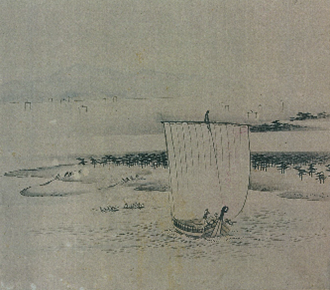
Settsu-no-kuni Wada-misaki(“Cape Wada in Settsu Province”)
Settsu Province spanned the northern part of present-day Osaka Prefecture and the southeastern part of present-day Hyogo Prefecture. Cape Wada projects out east over the sea off the southernmost part of Kobe Port. Awakapoem from theFuboku-wakasho, awakacollection compiled in the early 14th century, reads: “When I rowed out to Minato River, I heard a little cuckoo singing on a pine tree on Cape Wada.” Cape Wada was the site of a battle during the Kenmu War (1336), and the sea off its coast is called the “Wada Sea.” With the Akashi Strait to its west and the coastal areas of “Mukonoura” and “Ashiyaura” to its northeast, the cape was a popular tourist destination.
Settsu-no-kuni Wada-misaki(“Cape Wada in Settsu Province”)
Settsu Province spanned the northern part of present-day Osaka Prefecture and the southeastern part of present-day Hyogo Prefecture. Cape Wada projects out east over the sea off the southernmost part of Kobe Port. Awakapoem from theFuboku-wakasho, awakacollection compiled in the early 14th century, reads: “When I rowed out to Minato River, I heard a little cuckoo singing on a pine tree on Cape Wada.” Cape Wada was the site of a battle during the Kenmu War (1336), and the sea off its coast is called the “Wada Sea.” With the Akashi Strait to its west and the coastal areas of “Mukonoura” and “Ashiyaura” to its northeast, the cape was a popular tourist destination.
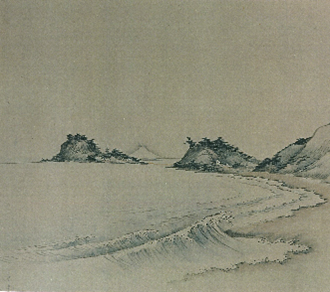
Sagami-no-kuni Kamakura Shichiriura(“Kamakura Shichiriura in Sagami Province”)
Shichirigahama is a beach stretching from Cape Inamura in the east to Cape Koyurugi in the west, located in Kamakura City, Kanagawa Prefecture. In 1333, when the Kamakura shogunate was under the control of the Hojo clan, Nitta Yoshisada offered a thick sword to the sea god at Cape Inamura and then conquered Kamakura, which was the home of the shogunate and known as a strong natural fortress surrounded by mountains in three directions and the sea in the other. This painting features a tranquil depiction of Mt. Fuji rising between Cape Inamura and Enoshima Island in the center; today, however, this location bustles with visitors enjoying swimming and other seaside activities.
よりよいエクスペリエンスを提供するため、当ウェブサイトでは Cookie を使用しています。引き続き閲覧する場合、Cookie の使用を承諾したものとみなされます。
We use cookies on our website to give you a better experience. If you continue browsing, we assume that you accept the use of cookies.